So, the other day during one of our day trips Monte and I stopped for lunch at a roadside restaurant. After we finished eating we got back in the car and on down the road we went.
About 40 minutes later I needed to look at a map and realized that I had left my glasses at the restaurant. You can imagine how happy Monte was when I told him we had to go back. All the way back Monte was the classic grouchy old man. He fussed, fumed, complained and huffed and puffed. He did eventually shut up but the scowl and glares were enough to freeze the rain that was hitting the windshield.
We finally got back to the restaurant and as I got out of the car and was hurrying inside I heard Monte yell at me “While you are in there you might as well get my hat and the credit card.”
Tuesday, July 6, 2010


Monday, July 5, 2010
The Snowy Range, Laramie, Wyoming
One of the day trips we took while in Cheyenne was along the Snowy Range Road. The Snowy Range is a mountain range within the Rocky Mountains.
The Snowy Range Road runs from Laramie, Wyoming to the Upper Platte River Valley and was designated the Second National Forest Scenic Byway in the United States. Started in 1920, it took 6 years to complete and was called the “Great Skyroad”. The byway runs through the heart of the Medicine Bow National Forest and even though we were there at the beginning of July, there was still an abundance of snow and most of the pull-offs and picnic areas were inaccessible due to snow. We found the this range of the Rocky Mountains to be spectacular. The stunning views of jagged gray granite peaks and beautiful blue lakes make this area very special.
Enough said – I'll let the pictures speak for themselves.


Cheyenne and Warren Air Force Base
Spent a few days camped at Warren Air Force Base in Cheyenne, WY.

It is a beautiful base, old red brick buildings and lots of green spaces and evergreen trees. Just a really nice place. This was enhanced by the wildlife on base. Everyday pronghorn antelope wander through the campground, lots of prairie dogs squeaking and whistling warnings as I walked the dogs, a large flock of Canada Geese, an abundance of cute little cotton tail rabbits. All of these critters added to our enjoyment.


If we had been a couple of weeks later we would have been in Cheyenne for Frontier Days – maybe next time.
Saturday, July 3, 2010
Ft. Laramie, Wyoming
Our next stop was only about 100 miles away - there is so much history in this area there is no way to stop and see each museum, old fort, trading post. However, we felt that this was an important stop to include.
Fort Laramie, the military post, was founded in 1849 when the army purchased the old Fort John for $4000, and began to build a military outpost along the Oregon Trail.

For many years, the Plains Indians and the travelers along the Oregon Trail had coexisted peacefully. As the numbers of emigrants increased, however, tensions between the two cultures began to develop. To help insure the safety of the travelers, Congress approved the establishment of forts along the Oregon Trail and a special regiment of Mounted Riflemen to man them. Fort Laramie was the second of these forts to be established.
The popular view of a western fort, perhaps generated by Hollywood movies, is that of an enclosure surrounded by a wall or stockade. Fort Laramie, however, was never enclosed by a wall. Initial plans for the fort included a wooden fence or a thick structure of rubble, nine feet high, that enclosed an area 550 feet by 650 feet. Because of the high costs involved, however, the wall was never built. Fort Laramie was always an open fort that depended upon its location and its garrison of troops for security.

In the 1850s, one of the main functions of the troops stationed at the fort was patrolling and maintaining the security of a lengthy stretch of the Oregon Trail. This was a difficult task because of the small size of the garrison and the vast distances involved. In 1851, the Treaty of 1851 was signed between the United States and the most important tribes of the Plains Indians. The peace that it inaugurated, however, lasted only three years. In 1854, an incident involving a passing wagon train precipitated the Grattan Fight in which an officer, an interpreter, and 29 soldiers from Fort Laramie were killed. This incident was one of several that ignited the flames of a conflict between the United States and the Plains Indians that would not be resolved until the end of the 1870s.
The 1860s brought a different type of soldier to Fort Laramie. After the beginning of the Civil War, most regular army troops were withdrawn to the East to participate in that conflict, and the fort was garrisoned by state volunteer regiments, such as the Seventh Iowa and the Eleventh Ohio. The stream of emigrants along the Oregon trial began to diminish, but the completion of the transcontinental telegraph line in 1861 brought a new responsibility to the soldiers. Inspecting, defending, and repairing the "talking wire" was added to their duties. During the latter part of the 1860s, troops from Fort Laramie were involved in supplying and reinforcing the forts along the Bozeman Trail, until the Treaty of 1868 was signed.
Unfortunately, the Treaty of 1868 did not end the conflict between the United States and the Plains Indians and, by the 1870's, major campaigns were being mounted against the plains tribes. The discovery of gold in the Black Hills, in 1874, and the resultant rush to the gold fields had violated some of the terms of the treaty and antagonized the Sioux who regarded the Hills as sacred ground. Under leaders such as Crazy Horse and Sitting Bull, they and their allies chose to fight to keep their land. In campaigns such as the ones in 1876, Fort Laramie served as a staging area for troops, a communications and logistical center, and a command post.


Conflicts with the Indians on the Northern Plains had abated by the 1880s. Relieved of some of its military function, Fort Laramie relaxed into a Victorian era of relative comfort. Boardwalks were built in front of officers' houses and trees were planted to soften the stark landscape.
By the end of the 1880s, the Army recognized that Fort Laramie had served its purpose. Many important events on the Northern Plains had involved the Fort, and many arteries of transport and communication had passed through it. Perhaps the most important artery, however, the Union Pacific Railroad, had bypassed it to the South. In March of 1890, troops marched out of Fort Laramie for the last time. The land and buildings that comprised the Fort were sold at auction to civilians.
Chadron, Nebraska
Heading north from Alliance, NE we stopped for the night in Chadron, NE. Why Chadron you ask? Simply to go to the Museum of the Fur Trade.
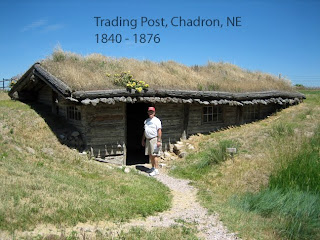
The Museum of the Fur Trade is located at the site of James Bordeaux's trading post. The trading post was established in 1837 by the American Fur Company. The company had just purchased Ft. Laramie, a hundred miles away and they planned to maximize their trade in prime buffalo robes by establishing posts in the protected valleys where the Indians wintered. Bordeaux prospered until after the Civil War when conditions on the Northern Plains were unsettled and the trade was often that of supplying contraband arms to Indians who were resisting efforts to force them onto reservations.
Bordeaux abandoned the post in 1872 and it was taken over by Francis Boucher, son-in-law of Spotted Tail, head chief of the Brule Sioux. Boucher's main interest was smuggling arms and ammunition to the Indian warriors fighting against the army. Undoubtedly, gunds and cartridges from his post figured in the defeat of General Custer. When the Army caught Boucher with 40,000 rounds of ammunition in 1876 they put him out of business.
The Museum traces the everyday lives of British, French, and Spanish traders, voyageurs, mountain men, buffalo hunters and the Plains and Woodland Indians. This small, privately funded museum is very well done and we glad we made the stop.

Remember those miles and miles of coal trains that I mentioned in an earlier post? Well, we found out what campground they all travel past. I guess our first hint should have been when the ad in the campground book said “If you love trains, this is the campground for you.” During the afternoon empty trains were rolling steadily past headed west. Along about sundown the fully loaded trains coming from Wyoming started rolling by, one after another, after another, after another. It was not that the trains were passing by but the fact that about 100 yards away was a RR crossing and so they have to blow their whistle, multiple times. There was more than once that I was sure a train was going to join us in bed.


WESTWARD HO!!
The Museum of the Fur Trade is located at the site of James Bordeaux's trading post. The trading post was established in 1837 by the American Fur Company. The company had just purchased Ft. Laramie, a hundred miles away and they planned to maximize their trade in prime buffalo robes by establishing posts in the protected valleys where the Indians wintered. Bordeaux prospered until after the Civil War when conditions on the Northern Plains were unsettled and the trade was often that of supplying contraband arms to Indians who were resisting efforts to force them onto reservations.
Bordeaux abandoned the post in 1872 and it was taken over by Francis Boucher, son-in-law of Spotted Tail, head chief of the Brule Sioux. Boucher's main interest was smuggling arms and ammunition to the Indian warriors fighting against the army. Undoubtedly, gunds and cartridges from his post figured in the defeat of General Custer. When the Army caught Boucher with 40,000 rounds of ammunition in 1876 they put him out of business.
The Museum traces the everyday lives of British, French, and Spanish traders, voyageurs, mountain men, buffalo hunters and the Plains and Woodland Indians. This small, privately funded museum is very well done and we glad we made the stop.


Remember those miles and miles of coal trains that I mentioned in an earlier post? Well, we found out what campground they all travel past. I guess our first hint should have been when the ad in the campground book said “If you love trains, this is the campground for you.” During the afternoon empty trains were rolling steadily past headed west. Along about sundown the fully loaded trains coming from Wyoming started rolling by, one after another, after another, after another. It was not that the trains were passing by but the fact that about 100 yards away was a RR crossing and so they have to blow their whistle, multiple times. There was more than once that I was sure a train was going to join us in bed.


WESTWARD HO!!
Subscribe to:
Posts (Atom)